Large ribosomally synthesized and post-translationally modified peptides, RiPPs, push the practical limits of spectroscopic structure elucidation. Severe signal overlap in repetitive sequences, coexisting rotamers, and the absence of suitable crystals can defeat NMR, tandem MS, and diffraction-based methods in turn. Marine cyanobacteria are a particularly rich source of such structurally complex metabolites, yet many producers remain uncultured, making direct genomic access impossible without a metagenomics approach. The gap between biosynthetic potential and chemical characterization is widest for molecules large enough to exceed what conventional spectroscopy can resolve, a problem that calls for an integrated, multi-evidence strategy.
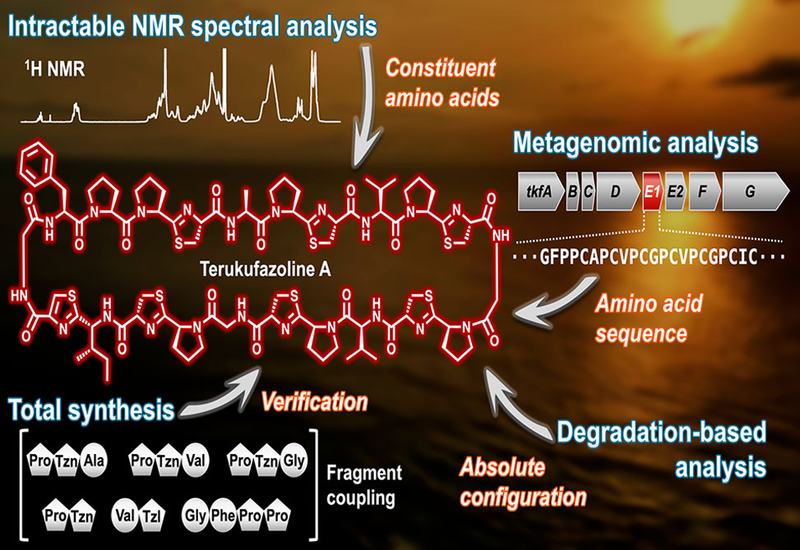
Researchers in the Iwasaki Lab at Chuo University and the Suenaga Lab at Keio University, published in J. Am. Chem. Soc., collected a marine cyanobacterium from Aguni Island, a remote Okinawan island, and isolated two novel macrocyclic peptides, terukufazolines A and B. Terukufazoline A proved immediately intractable: its 1H NMR spectrum in CD3OD showed severe signal overlap and a mixture of rotamers that persisted even after solvent screening. Partial acid hydrolysis, ozonolysis, derivatization, MicroED trials, and crystallization attempts all failed to establish the amino acid sequence. The team therefore combined spectroscopic analysis, shotgun metagenomic sequencing, chemical degradation, and convergent total synthesis to solve the structure.
Metagenomics recovered a patellamide-family biosynthetic gene cluster, tkf, most closely related to the tenuecyclamides cluster. The core peptide encoded by TkfE1, GFPPCAPCVPCGPCVPCGPCIC, matched exactly the 22 residues that NMR had identified in terukufazoline A: three Gly, Ala, two Val, Ile, Phe, one thiazole, six thiazolines, and seven Pro. With this sequence template in hand, reanalysis of the tandem MS data located the single thiazole unit adjacent to a Gly residue, completing the planar structure. Terukufazoline A is the first isolation-validated patellamide-type cyanobactin to reach the reported substrate-size ceiling of PatG-family macrocyclases, approximately 22 residues.
Absolute configuration determination required residue-by-residue interpretation of two complementary degradation methods. Ozonolysis followed by acid hydrolysis and chiral HPLC established L-configurations for all seven Pro residues and D-allo-Ile, but the thiazoline α-center proved prone to epimerization under these conditions. Direct acid hydrolysis in D2O/DCl with L-FDVDA derivatization showed no detectable deuterated Cys derivatives, confirming that the thiazoline α-centers carry the R configuration throughout. Total synthesis validated the complete stereostructure: a convergent fragment-coupling route used DEPBT and base-free allenone-mediated coupling to suppress epimerization at the labile thiazoline C-terminal carboxylic acid. Macrocyclization with DEPBT delivered synthetic terukufazoline A, whose NMR, IR, MS, and specific rotation data matched the natural product. Biological evaluation showed that both natural terukufazolines inhibit the growth of Trypanosoma brucei rhodesiense, the causative agent of African sleeping sickness, with IC50 values of 4.1 μM and 11 μM respectively, while the acyclic cyclization precursors were appreciably less active, pointing to the macrocyclic scaffold as a contributor to antiparasitic potency.
The terukufazoline study provides a worked example of what becomes possible when metagenomics, degradation chemistry, and total synthesis operate in series rather than in parallel. The genome-guided sequencing step was not a shortcut; it was the essential bridge that made chemical validation tractable. For the broader natural products community, the work highlights a recurring pitfall in thiazoline-containing peptides: ozonolysis-hydrolysis can epimerize the thiazoline α-center, so direct acid hydrolysis should serve as the primary method when multiple thiazoline units are present. The convergent fragment-coupling strategy, with its explicit epimerization-suppression logic, also offers a transferable blueprint for synthesizing other azoline-rich cyanobactins that approach the macrocyclase size limit.